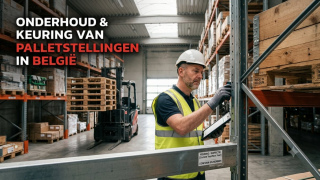
Warehouse racking may look like simple metal structures. Yet in Belgium, clear legal requirements apply to every rack — whether it is a small shelf unit in an SME or a large pallet racking system in a distribution centre. Ignoring these rules risks not only a fine, but above all dangerous situations for employees.
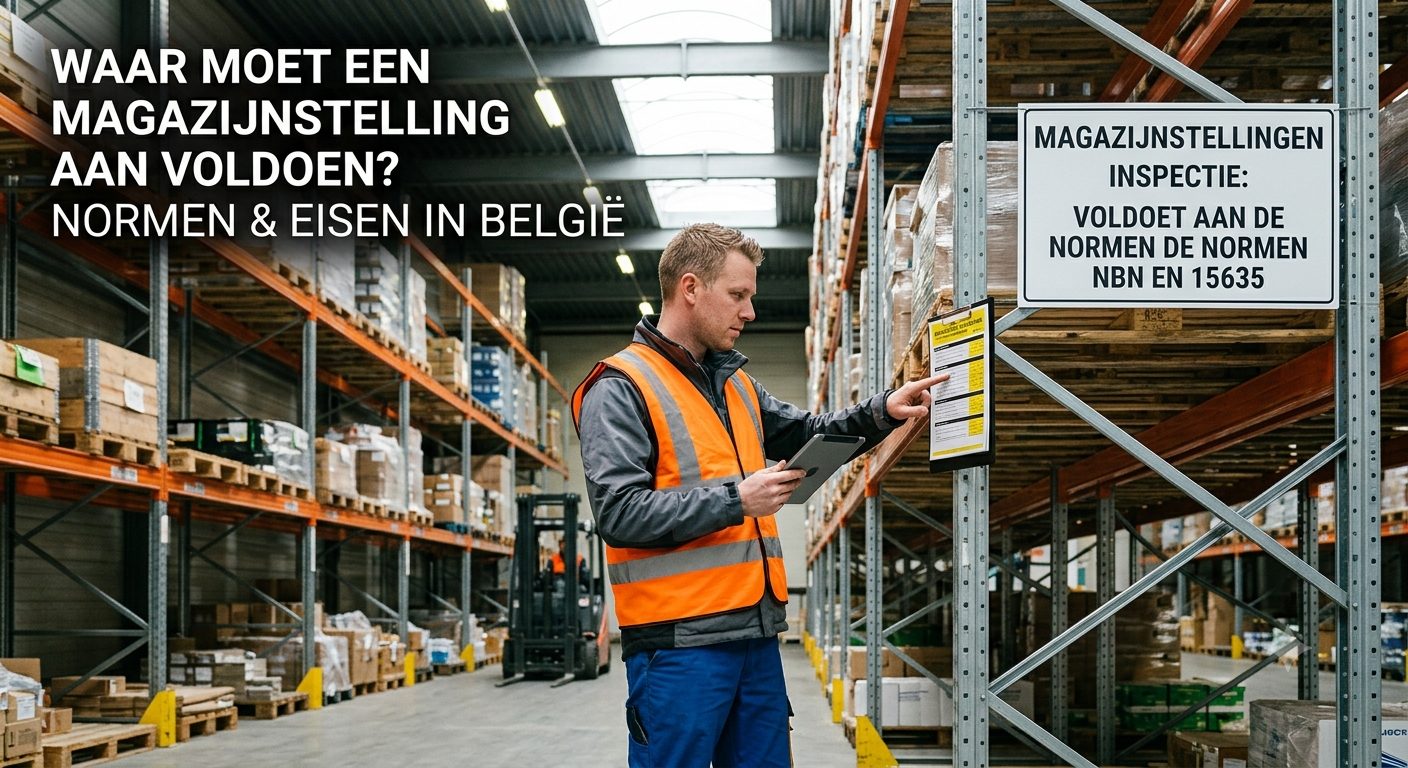
In this article, we explain which standards apply, what an inspection involves, and what to do if your racking no longer complies.
What is the legal basis in Belgium?
In Belgium, warehouse racking falls under the Codex on Well-being at Work. More specifically, the law obliges every employer to:
- Keep work equipment in good condition
- Regularly check whether equipment is safe
- Immediately repair defects or take the equipment out of service
Racking is considered work equipment as soon as employees come into contact with it. This means you, as employer or operator, are responsible for safety — even if the racking is used by a third party.
The European standard: EN 15512
The most important technical standard for steel shelf and pallet racking is EN 15512 — the European standard for steel static storage systems. This standard describes:
- The minimum structural strength of rack profiles, beams and connections
- Maximum permitted deformations and tolerances
- Calculation methods for load capacity
- Requirements for assembly and installation
This means every rack used in a professional environment must be designed and built according to EN 15512. For new racking this is normally guaranteed by the manufacturer. For second-hand racking this is less certain — always check that the documentation is available.
What is checked during an inspection?
1. Structural elements
- Uprights: any dents, bends or damage?
- Beams: deflection, deformation, damaged hooks
- Base plates and anchors: correctly mounted and fixed?
- Connection plates: cracks, corrosion, loose bolts
2. Load notices
Every rack must have a visible load notice showing:
- Maximum weight per bay (kg)
- Maximum weight per shelf or beam
- Name of manufacturer or installer
If this plate is missing, the racking is technically non-compliant.
3. Safety components
- Impact protection (base guards, column protectors)
- Beam locks (safety lock or equivalent)
- Clear access to emergency exits
How often must racking be inspected?
| Situation | Recommended frequency |
|---|---|
| Normal conditions (no forklifts) | Annually |
| Environments with forklifts or reach trucks | Every six months |
| After a collision or serious incident | Immediately |
| After renovation or relocation | Before putting back into service |
In addition to periodic inspection by an expert, a daily visual check by the warehouse manager is recommended. Small defects are spotted early before they become dangerous.
What if racking does not comply?
Green zone — minor damage with no effect on load capacity. Schedule repair within 4 weeks.
Amber zone — moderate damage affecting safety. The damaged bay must be unloaded and repaired as soon as possible.
Red zone — serious damage or risk of instability. The bay or entire rack must be immediately taken out of service until repaired or replaced.
Second-hand racking: extra attention required
- Not all second-hand racking is documented in compliance with EN 15512
- Components from different manufacturers must not be mixed unless approved by the designer
- Visual inspection at purchase is not sufficient — have an expert calculate the load values
At MagazijnService we only supply second-hand racking of which the technical specifications are known and verified.
Frequently asked questions
Must I keep an inspection report?
There is no legal obligation, but it is strongly recommended — especially in the event of an insurance claim or workplace accident.
Who may inspect racking?
An inspection may be carried out by an internal prevention advisor (level I or II) or by an external specialist. The inspector must have knowledge of EN 15512 and the specific racking systems.
Does EN 15512 also apply to shelf racking?
Yes, EN 15512 applies to all steel static storage systems, including shelf racking and archive shelving.
What does an inspection cost?
That depends on the size of the warehouse and number of racks. Contact us for a free quote.
Conclusion
Safe warehouse racking is not a luxury — it is a legal obligation and an investment in the safety of your employees. The EN 15512 standard, combined with Belgian welfare legislation, sets clear requirements for design, use and maintenance.
Do you have doubts about the condition of your racking, or would you like an inspection carried out? MagazijnService provides racking inspections and repairs across Antwerp and all of Belgium. Contact us for a free quote.